Advancing Equity in Education
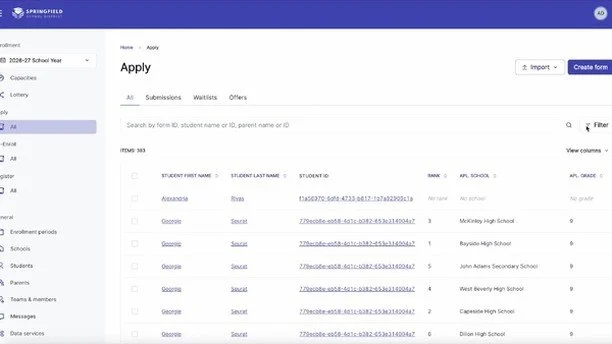
Avela is a platform for school districts and CMOs to make equitable, data-driven decisions on enrollment, class assignments, and teacher placement.
We empower school and district leaders to improve educational outcomes, equity, and accountability.
We are a team of educators, economists, and engineers bringing Nobel Prize-winning capabilities to all schools, districts, CMOs, and governments. We envision a world where all students have access to high quality, affordable education in a system that learns from each other and spreads best practices.
“With our algorithm, 30,000 students, roughly one-third of applicants, were able to choose their school, rather than being manually assigned. ”
“Choice matters. Getting your first choice school increases achievement by 0.4 standard deviations in Math and 0.14 in reading.”

In The News
The 2021 Nobel Memorial Prize in Economic Sciences honored the work of David Card, Joshua Angrist and Guido Imbens, which changed the way that labor markets in particular are studied.
Are exam schools really an academic promised land? Studies suggest students don’t do any better by attending ‘elite’ academies.
Getting a COVID-19 vaccine to the right people could change the course of the pandemic in the United States. But who are the right people?
Free online course offered in partnership with the Marginal Revolution University (MRU) and licensed under a Creative Commons Attribution-NoDerivatives 4.0 International License.
If you're looking to untangle cause and effect in a complex world, then econometrics is what you seek. Join MIT professor Josh Angrist and learn to master the econometrics "Furious Five": random assignment,regression, instrumental variables, regression discontinuity designs, and differences-in-differences methods.
Should a nurse or doctor who gets sick treating Covid-19 patients have priority access to a potentially life-saving healthcare device? Americans aren’t used to rationing in medicine, but it’s time to think about it. We consult a lung specialist, a bioethicist, and (of course) an economist.
The Atlantic
The Vietnam draft lotteries functioned as a randomized experiment—which has allowed social scientists to study its life-changing effects.
by Tim Johnson, Dalton Conley, and Christopher Dawes
Abdulkadiroğlu, Atila, Joshua D. Angrist, Yusuke Narita, and Parag A. Pathak. SEII Discussion Paper #2018.01 (2019).
Centralized school assignment algorithms must distinguish between applicants with the same preferences and priorities. This is done with randomly assigned lottery numbers, non- lottery tie-breakers like test scores, or both. The New York City public high school match illustrates the latter, using test scores, grades, and interviews to rank applicants to screened schools, combined with lottery tie-breaking at unscreened schools. We show how to identify causal effects of school attendance in such settings. Our approach generalizes regression discontinuity designs to allow for multiple treatments and multiple running variables, some of which are randomly assigned. Lotteries generate assignment risk at screened as well as unscreened schools. Centralized assignment also identifies screened school effects away from screened school cutoffs. These features of centralized assignment are used to assess the predictive value of New York City’s school report cards. Grade A schools improve SAT math scores and increase the likelihood of graduating, though by less than OLS estimates suggest. Selection bias in OLS estimates is egregious for Grade A screened schools.
Dur, Umut, Scott Duke Kominers, Parag A. Pathak, and Tayfun Sönmez. Journal of Political Economy 126, no. 6 (2018): 2457-2479.
We show that in the presence of admissions reserves, the effect of the precedence order (i.e., the order in which different types of seats are filled) is comparable to the effect of adjusting reserve sizes. Either lowering the precedence of reserve seats at a school or increasing the school’s reserve size weakly increases reserve-group assignment at that school. Using data from Boston Public Schools, we show that reserve and precedence adjustments have similar quantitative effects. Transparency about these issues—in particular, how precedence unintentionally undermined intended policy—led to the elimination of walk zone reserves in Boston’s public school match.
Parag Pathak’s research has lead to significant improvement in the assignment of students to public schools. For that work, he is awarded the prestigious John Bates Clark Medal by the American Economic Association.
Coordinated single-offer school assignment systems are a popular education reform. We show that uncoordinated offers in NYC’s school assignment mechanism generated mismatches. One-third of applicants were unassigned after the main round and later administratively placed at less desirable schools. We evaluate the effects of the new coordinated mechanism based on deferred acceptance using estimated student preferences. The new mechanism achieves 80 percent of the possible gains from a no-choice neighborhood extreme to a utilitarian benchmark. Coordinating offers dominates the effects of further algorithm modifications. Students most likely to be previously administratively assigned experienced the largest gains in welfare and subsequent achievement.
A growing number of school districts use centralized assignment mechanisms to allocate school seats in a manner that reflects student preferences and school priorities. Many of these assignment schemes use lotteries to ration seats when schools are oversubscribed. The resulting random assignment opens the door to credible quasiexperimental research designs for the evaluation of school effectiveness. Yet the question of how best to separate the lottery-generated randomization integral to such designs from non-random preferences and priorities remains open. This paper develops easily-implemented empirical strategies that fully exploit the random assignment embedded in a wide class of mechanisms, while also revealing why seats are randomized at one school but not another. We use these methods to evaluate charter schools in Denver, one of a growing number of districts that combine charter and traditional public schools in a unified assignment system. The resulting estimates show large achievement gains from charter school attendance. Our approach generates efficiency gains over ad hoc methods, such as those that focus on schools ranked first, while also identifying a more representative average causal effect. We also show how to use centralized assignment mechanisms to identify causal effects in models with multiple school sectors.
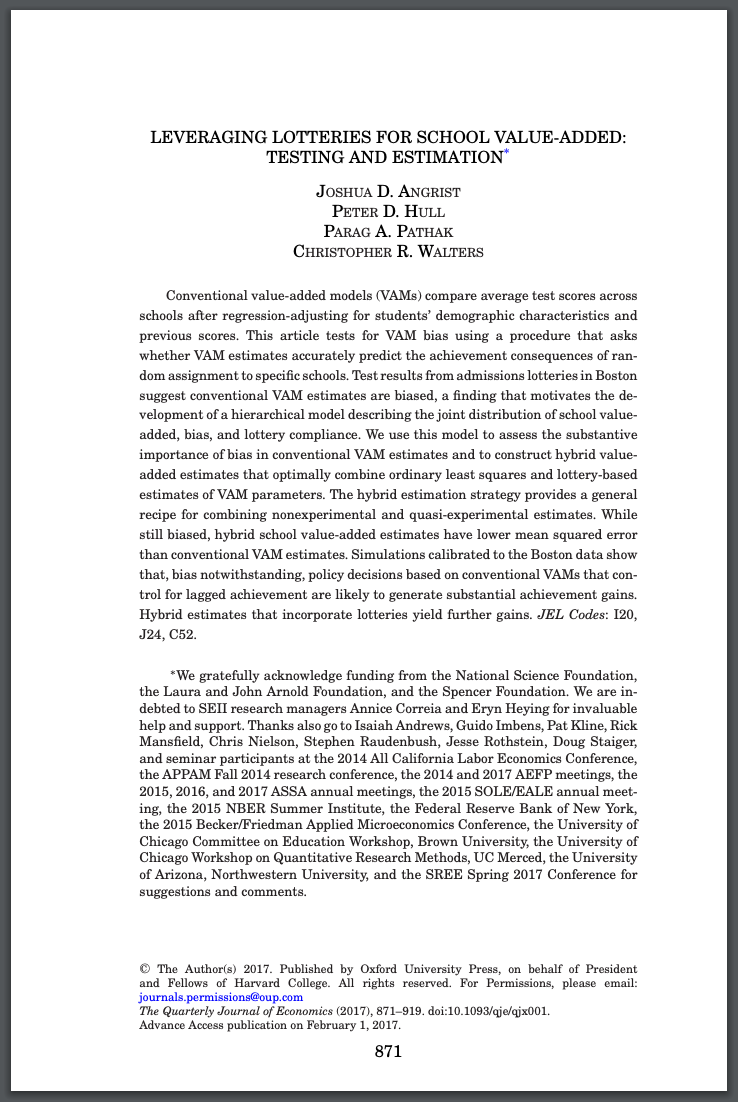
Angrist, Joshua D., Peter D. Hull, Parag A. Pathak, and Christopher R. Walters. The Quarterly Journal of Economics 132, no. 2 (2017): 871-919.
Conventional value-added models (VAMs) compare average test scores across schools after regression-adjusting for students’ demographic characteristics and previous scores. This article tests for VAM bias using a procedure that asks whether VAM estimates accurately predict the achievement consequences of random assignment to specific schools. Test results from admissions lotteries in Boston suggest conventional VAM estimates are biased, a finding that motivates the development of a hierarchical model describing the joint distribution of school value- added, bias, and lottery compliance. We use this model to assess the substantive importance of bias in conventional VAM estimates and to construct hybrid value- added estimates that optimally combine ordinary least squares and lottery-based estimates of VAM parameters. The hybrid estimation strategy provides a general recipe for combining nonexperimental and quasi-experimental estimates. While still biased, hybrid school value-added estimates have lower mean squared error than conventional VAM estimates. Simulations calibrated to the Boston data show that, bias notwithstanding, policy decisions based on conventional VAMs that control for lagged achievement are likely to generate substantial achievement gains. Hybrid estimates that incorporate lotteries yield further gains.
Do charter schools improve their students' test scores and later life outcomes? This can be a tough question to answer because even when charter school students succeed, it's not always clear that the charter school is what's responsible. Most researchers have studied results from charter school admissions lotteries, but critics worry that these studies don't tell us anything about how the vast number of students who don't wind up in admission lotteries would do in charter schools. In a study appearing in the July issue of the American Economic Review, authors Atila Abdulkadiroğlu, Joshua Angrist, Peter Hull, and Parag Pathak develop a new approach that can tell us more about how different kinds of students respond to charter education.