
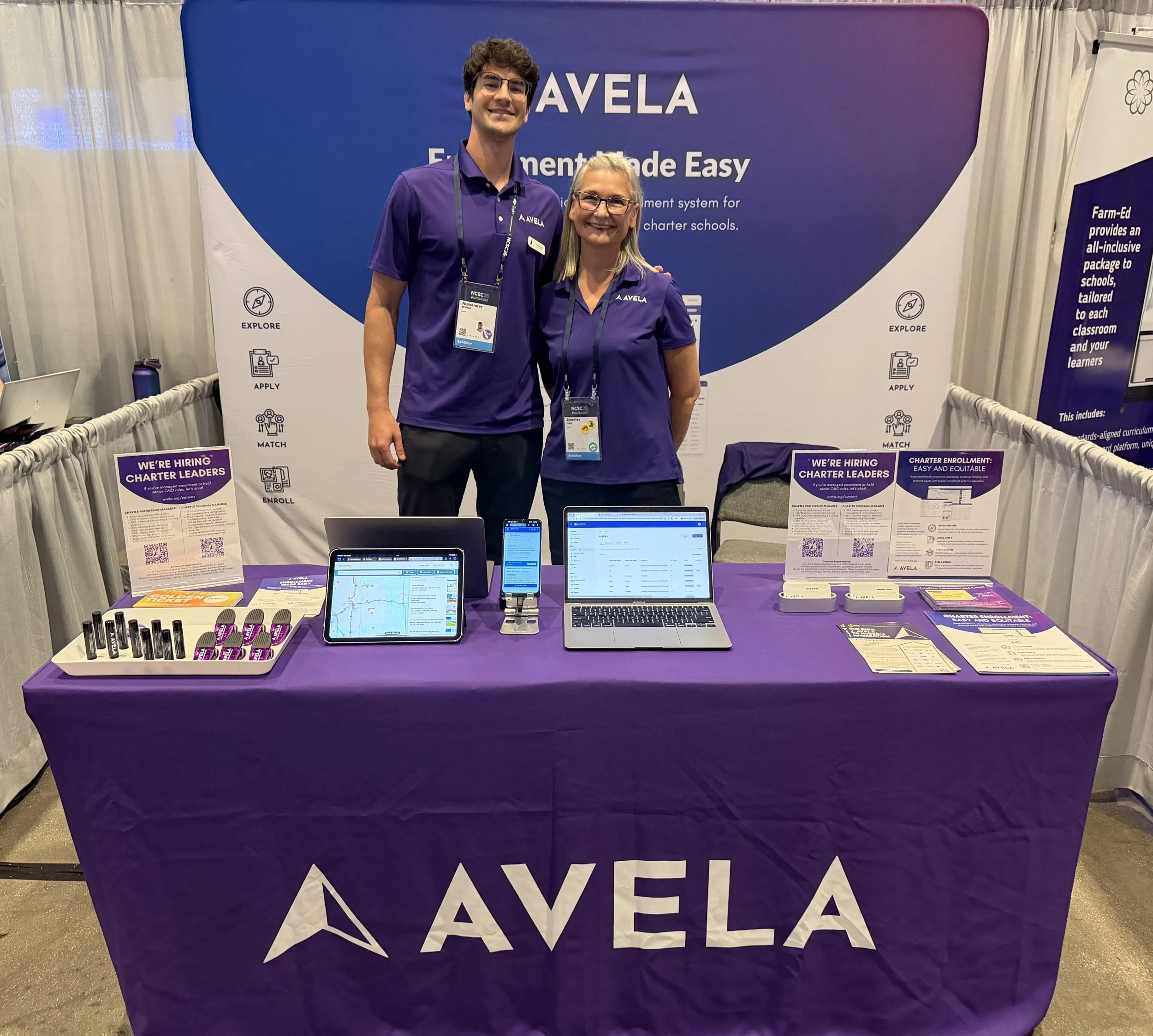
Avela team members Alex Weitzel and Jennifer Hurst at NCSC26
Last week, over 4,000 charter school leaders, educators, and advocates gathered in New Orleans for the 2026 National Charter Schools Conference. Between hosting a private reception for charter school leaders, talking with folks in the exhibit hall, and sitting in on as many sessions as we could fit into three days, we learned a lot.
A few points stuck out enough that we haven't stopped thinking about them since — here's what they were.
1. Families don't all want to enroll the same way
One idea we heard again and again is that families continue to have different preferences of how to move through enrollment.
Some families are digital-first. They want to do everything from their phone, and they'd rather get a text or an email than a phone call. Others are relationship-first — they want a call, a tour, or a real person walking them through each step. And plenty of families are simply convenience-first: they'll self-serve online one day and call the front office the next, depending on what else is going on in their lives.
The lesson here isn't that schools need more forms online. It's that equitable enrollment means offering multiple ways to complete the process — without creating more manual work for already-stretched staff. That balance came up again and again: how do you give families flexibility without making your enrollment team the bottleneck?
A few related pain points we heard directly from leaders on the exhibit hall floor:
Some parents are hesitant around technology — which is less a sign that families "don't trust tech" and more a signal that the tools they've been given aren't intuitive enough.
Staying in touch with families over the summer, and getting them to update student information, remains a persistent challenge (without the right tools).
Multilingual, accessible support — not just at application time, but across all school communications — is table stakes, not a nice-to-have.
These are the gaps Avela is built to close — one system that supports families throughout their enrollment journey, without adding more work to your staff's plate.
2. The enrollment funnel breaks in the connections, not the individual steps
Another theme that stood out: schools generating strong family interest often lose that momentum not because of any single weak step, but because the data behind it lives in too many disconnected places — spreadsheets, email tools, phone logs, separate enrollment systems. That fragmentation shows up as delayed follow-up, cold leads, and enrollment teams doing manual detective work instead of building relationships with families.
The riskiest stretch, based on what several presenters described, isn't the application itself — it's everything between an offer and the first day of school. Missing documents, families who decline simply because they ran out of time, auto-declines that could have been re-engaged, and summer melt all live in that gap. It's a part of the enrollment journey that deserves as much intentional design as the front-end application experience.
3. The parent perception gap is bigger than most schools realize
One of the more eye-opening sessions we attended looked at the gap between how families think their kids are doing academically and what the data actually shows. Leaders from St. Louis, Milwaukee, and the Fort Worth Education Partnership shared research and campaigns built around a simple but uncomfortable truth: most parents believe their child is doing better than they actually are.
One striking stat from Fort Worth's work in 2024: 96% of parents believed their child was reading at the right level. Actual proficiency? 52%. That 44-point gap was the largest of several perception gaps the partnership found, and they sprung into action to shrink that gap by improving student outcomes and improving parents’ access to information.
The pattern across the cities was similar:
Parents take action when they understand where their child actually stands. The gap itself is often the barrier to engagement, not apathy.
Closing that gap takes more than one channel. One district described building "surround sound" — landing pages, short videos, digital ads, podcasts, and messaging all reinforcing the same core question: is your child where you think they are?
An intermediary between schools and families — something that translates performance data into something parents can actually act on — was consistently described as the missing piece.
4. AI is changing how families first find out about charter schools
A handful of sessions covered how AI-powered search and chat tools are now answering questions about charter schools directly — often without a click to a school's own website — and what that means for how schools should think about their online presence and narrative going forward. It's a natural extension of the "surround sound" idea above: if AI answer engines are becoming another channel families use to learn about your school, that's one more place where the story you tell needs to be accurate and easy to find.
This relates to a recent blog post that Avela published, How Charter Schools Can Show Up in AI Search.
AI showed up in classroom-facing conversations too, not just marketing and enrollment — several sessions covered how school leaders are piloting AI-powered instructional coaching and feedback tools, a reminder that this year's "Technology, AI, and Career-Focused Learning" focus area reached well beyond our corner of the sector.
The Throughline
Every one of these conversations — digital-first versus relationship-first families, the leaky funnel, the perception gap, even AI's growing role in how families find schools — points to the same underlying idea: families need multiple, honest, well-connected ways to understand and engage with a school, and staff need systems that make offering that flexibility sustainable rather than exhausting.
Avela is proud to support charter schools around the country in solving exactly this — improving the entire experience families have with their schools. We'll keep building new ways to make enrollment easier and more flexible for families, and simpler to manage for admins. Thank you to everyone we spoke with at our booth, our reception, in sessions, and everywhere in between. NCSC was a fantastic event, and it's left us with a lot to think about as we work to support the success of charter schools everywhere.
Curious what a modern enrollment system would look like for your school? Request a demo of Avela.
