
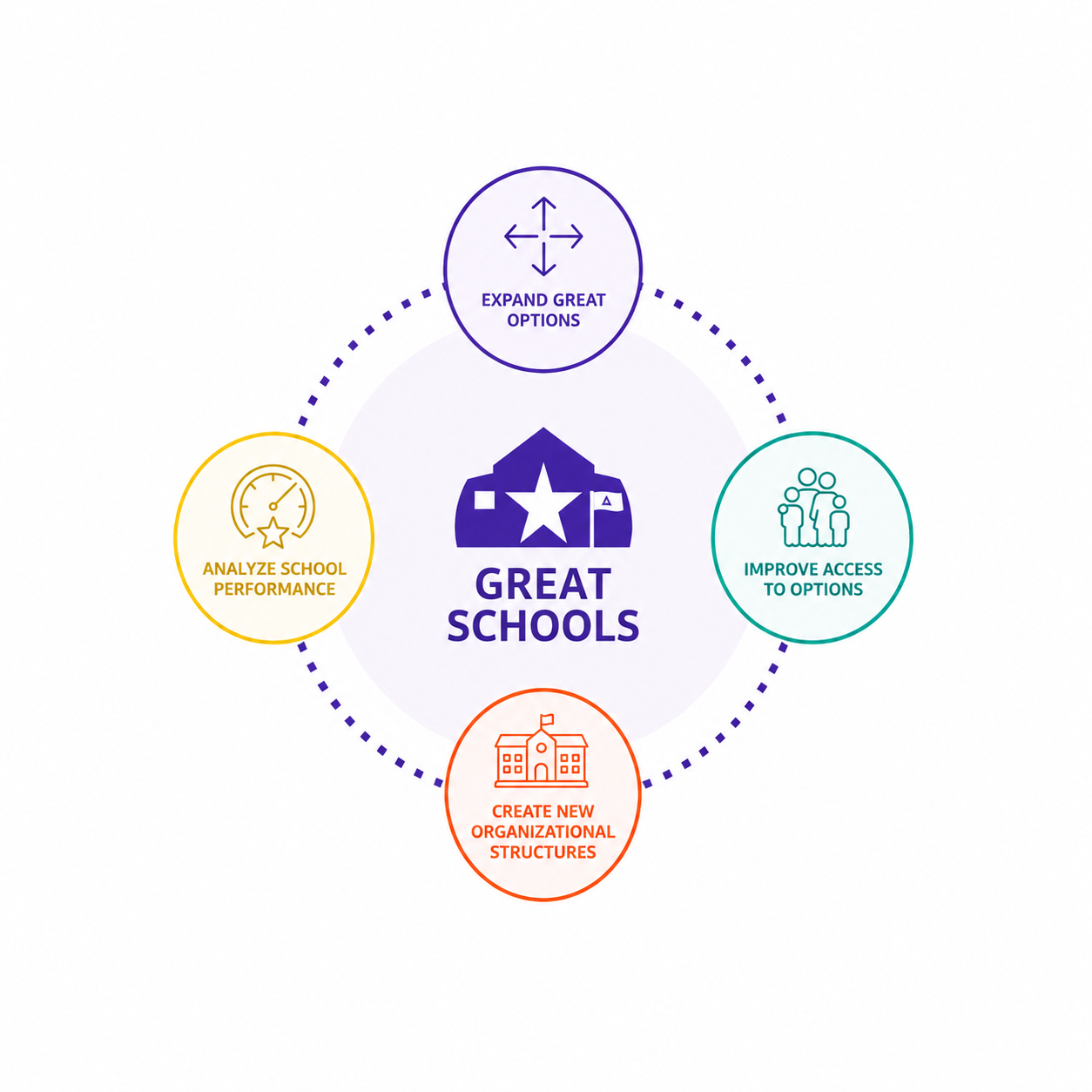
The System of Great Schools (SGS) strategy has an ambitious goal: help more Texas students attend high-quality, best-fit schools.
For participating districts, achieving that goal requires more than improving individual campuses. District leaders must understand where great options exist, identify where more are needed, expand successful programs, and ensure families can actually access those opportunities.
Technology can’t do that work for a district. But the right technology can make it much easier to execute, measure, and improve. That’s where Avela can help.
Avela provides districts with a unified platform for school discovery, applications, lottery and assignment, enrollment, and family communications. At the same time, it gives district leaders valuable information about what families are choosing, where demand exists, and where families may be encountering barriers.
1. Analyze School Performance: Add Family Demand to the Picture
SGS districts conduct a Quality Seats Analysis (QSA) to understand where students have access to strong schools and where additional or different options may be needed.
Academic and demographic data are critical to that analysis. But enrollment data can add another valuable perspective: What are families actually choosing?
Avela can help districts identify patterns such as:
Schools and programs receiving the most applications
Programs families rank most highly
Locations where waitlists consistently form
Programs with significant unfilled capacity
Neighborhoods generating demand for options elsewhere
Differences in application or enrollment patterns among student populations
A 300-seat program receiving 900 applications every year tells district leaders something important. So does a new program struggling to fill its available seats.
Enrollment isn’t just an administrative process. It’s a source of strategic information.
Avela partner district Garland ISD saw participation in its choice programs growfrom 4,520 students to 8,002 after creating a clearer way for families to discover and access the district’s options. That growth gave more families access to programs such as early college and P-TECH while also giving district leaders a richer picture of which opportunities families were actively seeking.
2. Expand Great Options: Understand Where Families Want More
One of the central ideas behind SGS is that districts should actively expand access to successful schools and programs.
That can mean creating new schools, replicating successful models, expanding existing programs, redesigning campuses, or developing partnerships. Avela helps districts bring family demand into those decisions.
If an academy consistently generates a long waitlist, leaders can examine whether there is an opportunity to increase capacity or replicate the model elsewhere.
If another program isn’t attracting families, leaders can investigate why. Is the issue the program itself—or awareness, location, transportation, communication, or a complicated application process?
When application, preference, assignment, waitlist, and enrollment information are connected, districts gain a clearer picture of how families are responding to their portfolio of options.
Avela partner district San Antonio ISD has added more than 10,000 A/B seats and substantially expanded the number of high-quality campuses available to families through its broader System of Great Schools work. As that portfolio has grown, Avela has supported the district’s family-facing enrollment process, helping provide families with a consistent way to navigate and access an increasingly diverse set of educational options.
3. Improve Access to Options: Make Choice Easier for Families
This is perhaps the clearest connection between Avela and the SGS strategy.
TEA’s vision for unified enrollment includes a simple idea: One application. One timeline. One lottery. One assignment.
Avela was built to support exactly this kind of coordinated enrollment experience.
With Avela Explore, families can discover schools and programs through a searchable, accessible school finder rather than piecing together information across multiple websites and PDFs.
With Avela Apply, districts can bring applications for different schools and programs into a more consistent family experience while still supporting individual eligibility requirements and workflows.
With Avela Match, districts can manage complex assignment rules—including priorities, preferences, reserved seats, and tie-breakers—through a transparent and auditable process.
And with Avela Enroll, families can continue from an offer into registration without starting an entirely disconnected process.
The result is a much simpler journey: Explore → Apply → Match → Enroll
That’s important because offering great schools isn’t enough. Families need a fair and understandable way to access them.
Garland ISD also significantly streamlined the administrative side of enrollment. Application processing time fell from roughly an hour per family to approximately 12–15 minutes — a reduction of more than 80% — while families could apply across multiple programs without repeatedly uploading the same information.
4. Build Sustainable Central Office Structures: Create Infrastructure That Scales
As an SGS district expands its portfolio, its administrative workload can expand too.
Every new academy, pathway, partnership, transfer option, or specialized program can potentially bring another application, eligibility process, spreadsheet, lottery, waitlist, communication plan, and reporting requirement. Eventually, innovation itself becomes difficult to administer.
A centralized enrollment platform creates infrastructure that can grow alongside the district’s portfolio. Rather than building a new process every time a program launches, districts can incorporate new opportunities into an established family experience.
Central-office and campus teams can also work within the same system using role-based access, giving program leaders the tools they need while maintaining district-level visibility and oversight.
That makes the infrastructure supporting school choice more sustainable as the portfolio becomes more sophisticated.
Avela partner district Midland ISD,which serves approximately 29,000 students across 40 campuses, moved away from a custom-built legacy enrollment system that had become difficult to modify and created challenges such as duplicate family accounts and login issues. With Avela, the district introduced bulk actions and automated workflows, distributed appropriate verification work to campuses, and gained the flexibility to adjust enrollment processes without commissioning custom software development.
The Bigger Opportunity: Turn Enrollment Into a Feedback Loop
Perhaps Avela’s most important contribution to an SGS strategy isn’t any single feature. It’s connecting the family experience with the district’s strategic decision-making.
Families need answers to straightforward questions: What options are available to my child? Which schools fit our needs? How do I apply? Did we receive a seat? What happens next?
District leaders need answers to a different set of questions: What do our families want? Where is demand exceeding supply? Who is accessing our highest-demand programs? Where are families dropping out of the process? What should we expand next?
Those questions are connected. A modern enrollment ecosystem can create a continuous feedback loop: Understand demand → Improve access → Measure results → Expand successful options → Repeat
That’s much bigger than putting an application online. It’s infrastructure for managing a system of great schools.
From SGS Strategy to Family Experience
Texas’s System of Great Schools strategy recognizes that educational opportunity isn’t simply about creating more programs. Districts also need to make sure families can find those programs, understand their options, access them equitably, and successfully enroll.
For SGS districts, that creates an important question: Do the systems families use every day support your SGS strategy—or make it harder to achieve?
Avela can help connect the work happening in the boardroom and Office of Innovation with the experience happening on a parent’s phone. Because creating great options is only part of the equation. Families need a simple, fair, and transparent way to access them.
We’d love to meet with you to discuss how we can help your district achieve the SGS goal of helping more Texas students attend high-quality, best-fit schools.
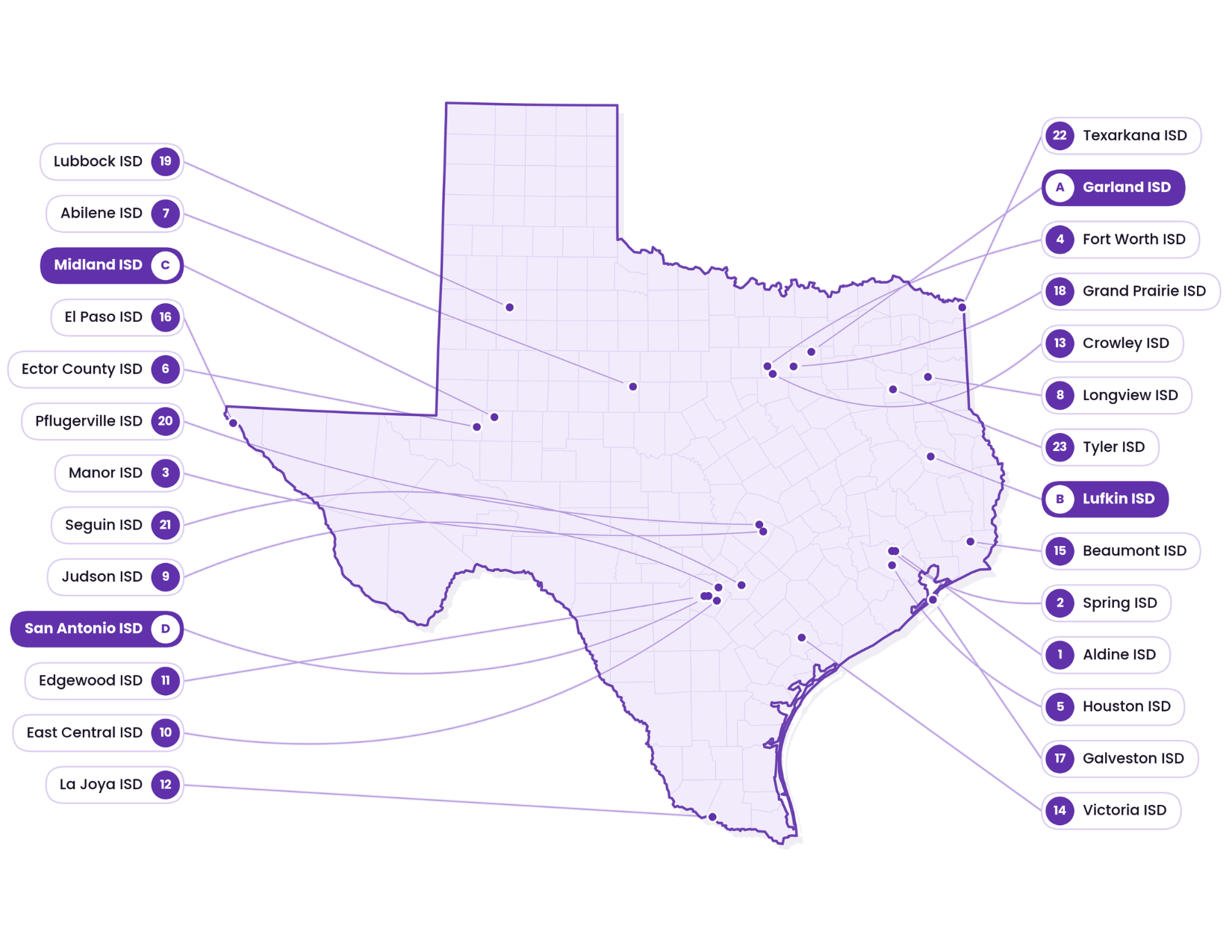
Map of SGS Districts, including Avela partner districts in purple
